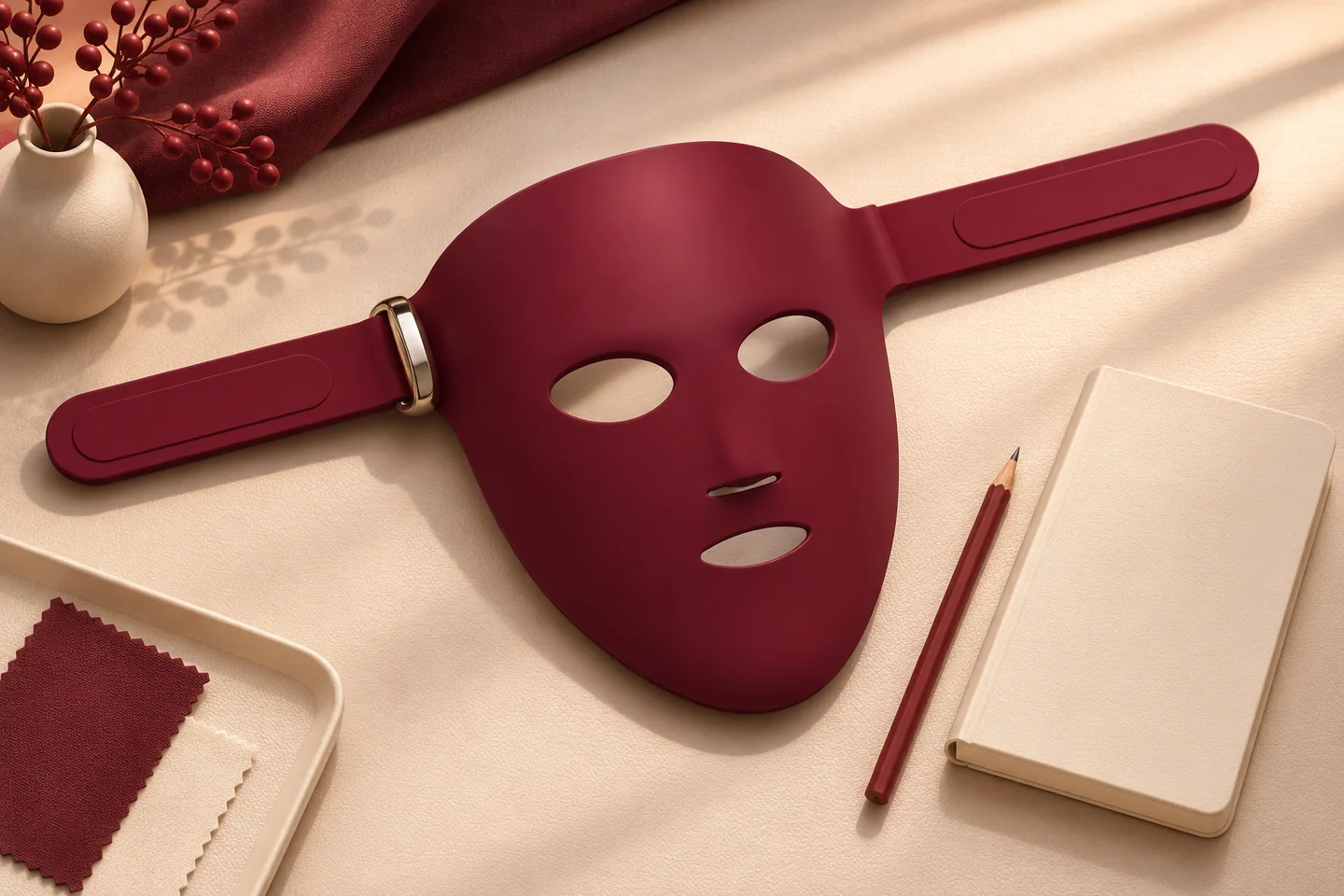
Before approving an OEM LED face mask sample, ask a small group of intended users to try on a sample built to the proposed production specification. Use the draft retail instructions and record where the mask shifts, where it feels uncomfortable and which steps users can complete without help.
AI-generated concept illustration based on the Lumiyan RB-096A. Product features may differ from the illustration.
Product reference: https://www.lumiyan.com/rb-096a-magnetic-led-face-mask.html
Start with an unassisted fitting
Use the strap and accessories intended for the retail box. With the sample powered off, give each participant the proposed quick-start guide and ask them to put it on without coaching. Observe whether they can identify the correct strap orientation, find the adjustment points and remove the mask without help.
Record fit by area
• Nose bridge: Record pressure points and whether tightening a strap increases pressure.
• Cheeks and jaw: Note gaps at rest and check whether the mask shifts when the wearer gently turns their head. After an adjustment, check the nose bridge and eye openings again.
• Eye openings: Record alignment and whether adjustment pulls the openings out of position.
• Straps: Record remaining adjustment range, slippage and whether hair or the strap routing affects repeatability.
Document visible gaps and request model-specific measurements for any light-output assessment. Consumer discussions identify nose-bridge fit and lower-face gaps as two areas to check during fitting.
Nose-bridge discussion: https://www.reddit.com/r/koreanskincare/comments/1pwlqac/led_face_masks/
Lower-face discussion: https://www.reddit.com/r/30PlusSkinCare/comments/188tfgn/omnilux_mask_fit_issues/
Turn findings into sample approval criteria
Agree with the supplier on the fit criteria before the review. For each issue, record the sample revision, the affected area, the strap setting and whether the issue recurs after the wearer takes the mask off and puts it back on. Ask the supplier whether a change to the straps, shell or instructions would address the issue. Repeat the same fitting steps after any revision and retain the approved sample and quick-start guide as production references.
Sample fit acceptance worksheet
Create one record per wearer and fit area. Use the draft instructions for each refit. In the example below, replace each example value with your own observation.
| Sample & guide revision | Wearer ID & fit area | Strap routing & setting | Observation & repeatability | Decision & next check |
|---|---|---|---|---|
| Example only: S02 / Guide v1 | W03 / Nose bridge | Upper strap in the guide position, lower strap at midpoint | Pressure after tightening. Recurred on refit. | Adjust. Review lower strap routing, then recheck the nose bridge and eye openings. |
| ________ | ________ | ________ | ________ | ________ |
Accept: The recorded result meets the agreed fit criteria. Record the approved revisions.
Adjust: Record the change needed to the strap, shell or instructions and who will make it.
Retest: Record the revised sample or guide version, repeat the fitting and log the outcome.
Request an OEM fit sample
Send the reference model and destination market, the sample quantity, estimated first order quantity and target review date. Include known nose bridge, jaw, eye alignment or strap concerns, the strap or accessory options to compare and the language needed for the draft quick-start guide. Ask which sample revision, straps and draft instructions are available to review.
OEM sample requests: https://www.lumiyan.com/oem-odm.html
Browse Lumiyan LED face mask models: https://www.lumiyan.com/led-face-masks.html